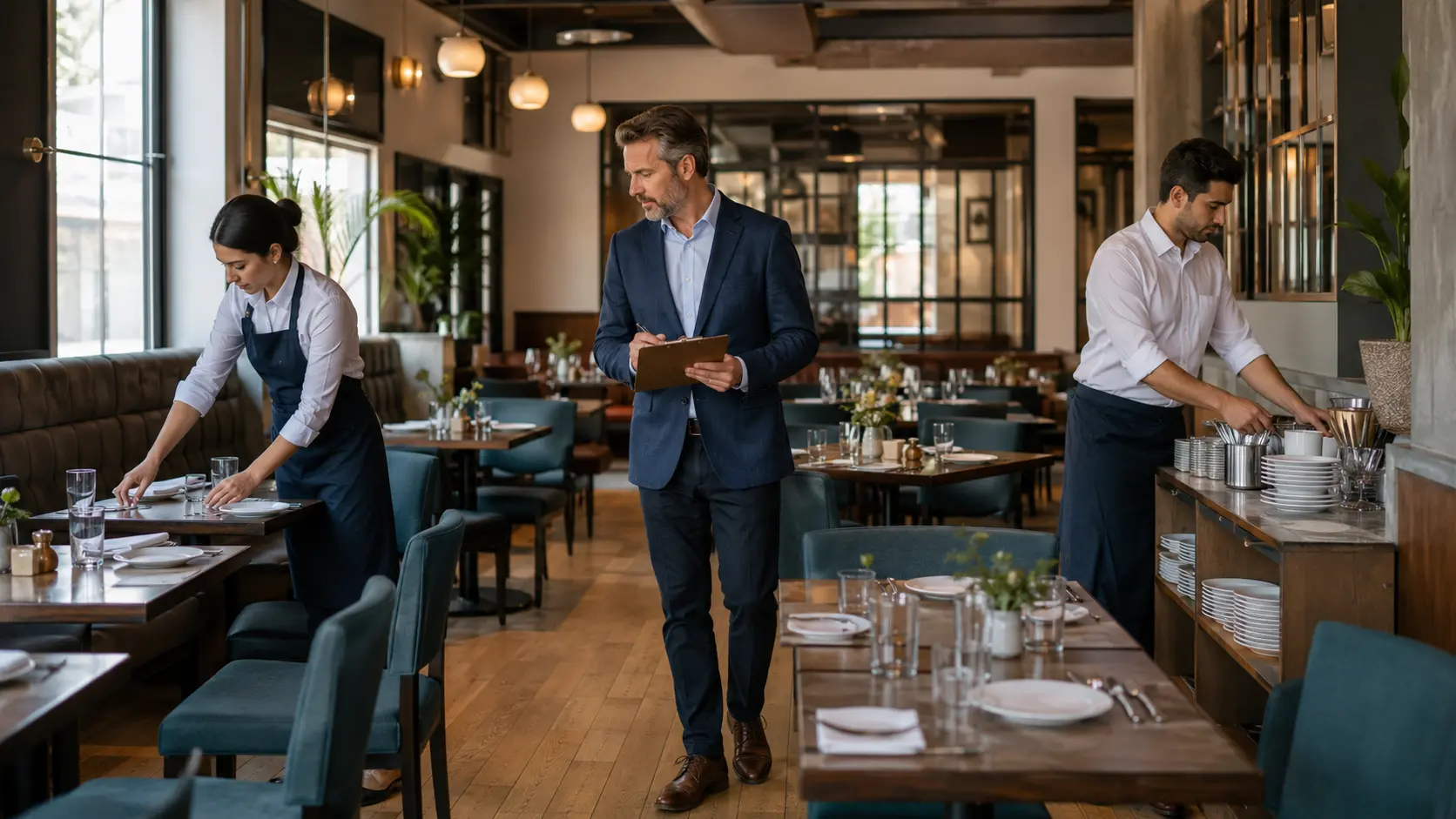
A restaurant can look almost ready while still carrying several problems into service: an unavailable dish has not reached the host team, a payment terminal is offline, a section is missing glassware and the kitchen is waiting for a delivery nobody has followed up.
A restaurant opening and closing checklist should prevent these problems from reaching the guest and leave the venue properly prepared for the next team.
The value is not in ticking boxes. It is in confirming that the restaurant is genuinely ready to open and properly controlled before the final manager leaves.
Key Takeaways
- Divide opening and closing tasks by role, area and required completion time.
- Give the manager responsibility for verification, not for completing every task personally.
- Record faults, shortages and unfinished work instead of hiding them behind a completed checklist.
- Follow approved company procedures for food safety, cash, keys, alarms and security.
- Review repeated failures and correct the process, training or resources behind them.
The Operational Problem
Many restaurants already have opening and closing lists, but they are often too general, out of date or completed from memory.
“Check the restaurant” does not explain the standard. “Clean the station” does not identify which station, who owns it or who confirms the result. Employees may tick every item while the manager still finds missing stock, incomplete preparation or an unresolved fault.
Build the Checklist Around Responsibility
Separate tasks into front of house, back of house, bar and management. For each task, identify:
- The task and expected standard
- The person or role responsible
- When it must be completed
- Whether manager verification is required
- What comment is needed when the task fails
- Who receives the escalation
Avoid making one employee responsible for an entire area without dividing the work. A closing server may reset tables, restock a service station and report damaged equipment, while the supervisor completes the final walkthrough.
Restaurant Opening Checklist
Opening should move from access and safety to operational readiness, then to guest readiness.
Manager checks
- Review the previous shift handover and confirm unresolved actions.
- Check reservations, groups, VIPs, events and expected pressure periods.
- Confirm attendance, role allocation and any staffing gaps.
- Review unavailable items, deliveries, maintenance issues and operational changes.
- Confirm that required systems and guest-facing equipment are working.
- Assign ownership and deadlines for anything not ready.
Front-of-house checks
- Inspect the entrance, dining room, restrooms and guest circulation areas.
- Confirm table settings, menus, reservations and section plans.
- Prepare service stations with the required clean equipment and supplies.
- Test relevant ordering, payment and communication equipment under company procedures.
- Remove outdated menus, promotional material or availability information.
Back-of-house checks
- Complete required equipment, storage and food-safety checks using the restaurant’s approved procedures.
- Confirm preparation priorities, station readiness and expected volumes.
- Check deliveries, shortages, unavailable ingredients and approved substitutions.
- Ensure current allergen and recipe information is accessible to authorised employees.
- Report any condition that could affect safe production or service.
Bar and beverage checks
- Confirm glassware, ice, garnishes, coffee, beverages and service tools are ready.
- Check unavailable products and approved alternatives.
- Test relevant equipment and report faults before service.
- Prepare stock according to expected business rather than habit alone.
Food-safety tasks must reflect the approved food-safety system and local requirements. If a control is uncertain, employees should stop and escalate to the authorised chef or manager rather than guess.
Complete a Final Readiness Walk
The manager should walk the operation before opening. Do not verify from the office or accept a completed box as proof that the standard has been met.
Follow the guest’s path through the entrance, host point, dining room, restrooms and visible service areas. Review pressure points with the kitchen and bar. Fix, formally accept or escalate every unresolved item.
The opening manager can then use this verified information to run the pre-shift briefing.
Restaurant Closing Checklist
Closing is the controlled reset of the restaurant for the next service.
Front-of-house closing
- Complete guest-facing close-down tasks only when service allows.
- Clear, clean and reset assigned areas to the approved standard.
- Return equipment and supplies to their designated locations.
- Record lost property, damage, guest follow-up and unresolved requests through approved procedures.
- Report shortages rather than leaving the opening team to discover them.
Back-of-house closing
- Store, label, dispose of and rotate food according to approved food-safety procedures.
- Complete required cleaning, waste and equipment checks.
- Record preparation still needed for the next service.
- Report equipment faults, stock concerns and incomplete safety actions.
- Shut down equipment only as authorised by the manufacturer and company procedure.
Manager closing checks
- Confirm all departments have completed their assigned responsibilities.
- Review payment, cash and end-of-day controls using the approved financial procedure.
- Check incidents, guest recovery, staffing concerns and maintenance follow-up.
- Confirm required access, key, alarm and security controls without placing sensitive details in an informal checklist.
- Record open actions with an owner and next step.
Items still open at closing should become part of a structured shift handover, not a message that may be missed the following morning.
Manage Exceptions, Not Just Completion
The most useful part of a checklist is often the failed item. A failed check gives the manager time to act before the problem reaches a guest or the next shift.
Use clear statuses such as completed, not completed, not applicable and escalated. Require a short comment for anything not completed. Never encourage employees to tick an item simply to finish the list.
Review patterns weekly. If glassware is repeatedly short, a refrigerator check is often late or the same closing task fails every Saturday, investigate workload, timing, equipment, stock levels and training before assuming the employee is careless.
Common Mistakes
- Using one checklist for every role: Ownership becomes unclear and tasks are duplicated or missed.
- Writing vague instructions: Employees interpret the expected standard differently.
- Checking everything at the end: Problems are found when there is no time left to correct them.
- Accepting ticks without verification: Completion is recorded but readiness is not confirmed.
- Keeping outdated items: Staff stop trusting a checklist that does not match the operation.
- Using the checklist to punish reporting: Employees hide failures instead of escalating them early.
Manager Checklist
Before opening or leaving the venue, confirm:
- Every area has a named person responsible.
- Safety-critical checks follow approved procedures.
- Faults, shortages and unavailable items have been escalated.
- The manager has physically verified priority standards.
- Incomplete tasks have an owner, status and next action.
- The next team can access the required information.
- Repeated failures are reviewed for root causes.
Conclusion
An effective restaurant opening and closing checklist creates a reliable standard across different employees, supervisors and shifts. Keep each task specific, assign ownership and make exceptions visible. The aim is not a perfectly completed form. It is a restaurant that opens ready, closes under control and does not pass avoidable problems to the next team.
Frequently Asked Questions
What should be included in a restaurant opening checklist?
A restaurant opening checklist should cover manager, front-of-house, back-of-house and bar readiness. Include staffing, reservations, guest areas, service stations, equipment, stock, menu availability, preparation and approved safety checks. Each task should identify an owner and completion time. The manager should verify priority standards and assign a clear action for anything that is not ready.
What should be included in a restaurant closing checklist?
A closing checklist should cover cleaning, resetting, stock, food storage, waste, equipment, payments, guest follow-up, maintenance and security controls relevant to the venue. Separate responsibilities by department and require incomplete items to be recorded. Cash, food safety, keys, alarms and incident information should always be managed through approved company procedures rather than generic instructions.
Who should complete restaurant opening and closing checklists?
Team members should complete the tasks assigned to their roles, while the supervisor or manager verifies priority standards and handles exceptions. The manager should not perform every task personally. Clear ownership allows employees to act independently while ensuring somebody remains accountable for the final decision that the restaurant is ready to open or properly controlled at close.
How often should a restaurant checklist be updated?
Review the checklist whenever the menu, equipment, layout, service model or company procedure changes. Managers should also examine repeated failed or irrelevant tasks during regular operational reviews. A checklist that no longer matches the venue quickly loses credibility. Any change involving safety, security, employment or financial controls should be approved by the responsible specialist before implementation.
Should restaurant checklists be paper or digital?
Either format can work if the checklist is accessible, current and reviewed. Paper may suit a small operation, while a digital system can improve visibility across shifts and locations. The important controls are clear ownership, time of completion, exception reporting and manager follow-up. The chosen format should also comply with company requirements for access, privacy and record retention.