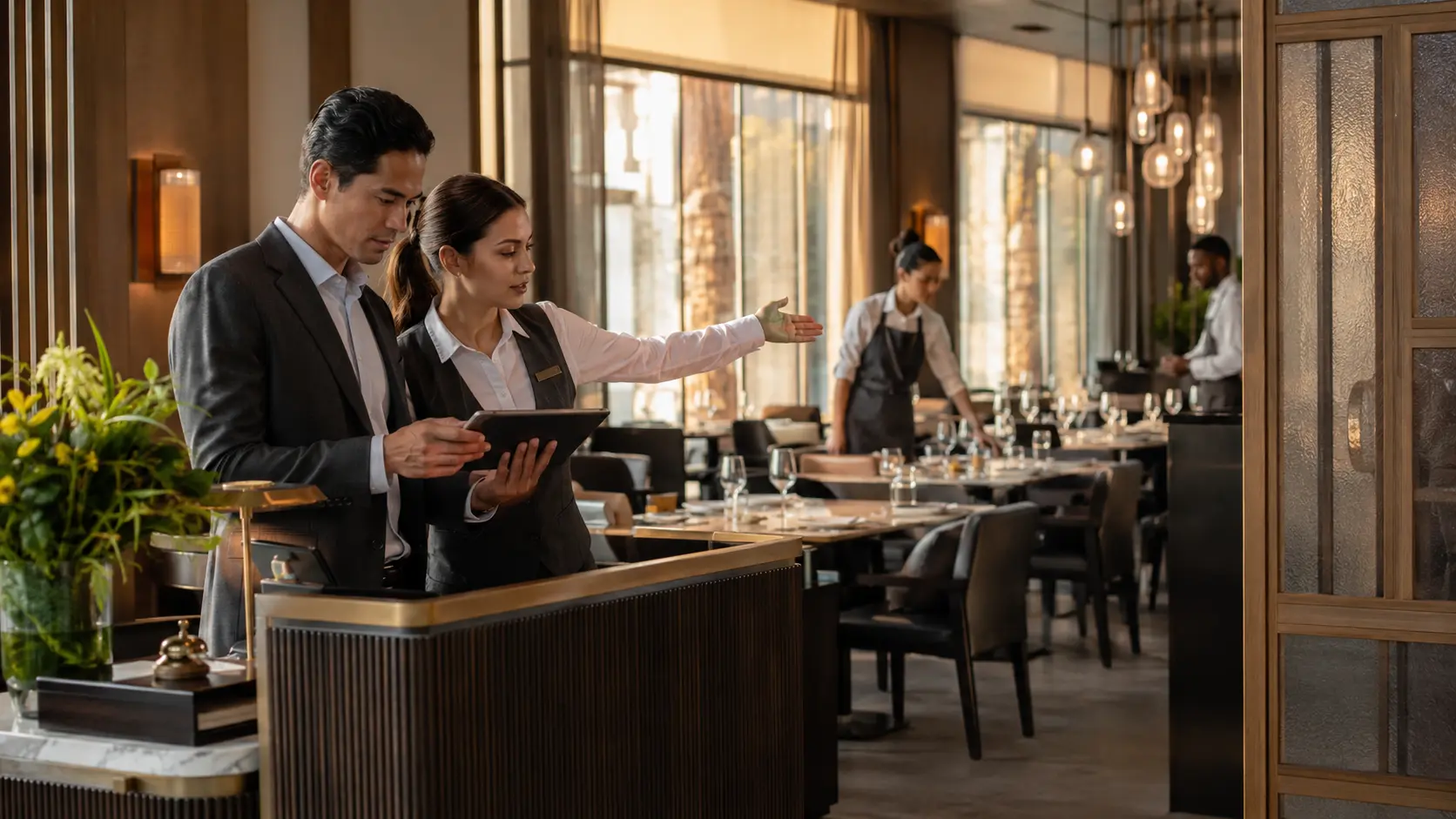
A restaurant can be fully booked on paper and still begin service with empty tables, an overloaded kitchen and guests waiting at the entrance. A late cancellation may not reach the floor plan. Several parties may be promised the same preferred table. Important requests may sit in free-text notes that no one verifies before arrival.
Effective restaurant reservation management connects booking information with table capacity, arrival pacing, team preparation and live service decisions. Its purpose is not simply to fill seats. It is to create a reliable guest commitment that the operation can actually deliver.
Key Takeaways
- Record complete, accurate and service-relevant information at the time of booking.
- Control arrival patterns and table duration instead of judging capacity by total covers alone.
- Separate confirmed reservations, enquiries, waitlists and unverified requests clearly.
- Review special arrangements and operational risks before the pre-shift briefing.
- Keep one current reservation position during service and record outcomes for future planning.
Why Reservation Management Fails
Most reservation problems are created before the guest reaches the restaurant. Information arrives through telephone calls, websites, hotel teams, messages, social media or third-party channels. If these sources are not reconciled, the operation can hold duplicate bookings, miss cancellations or work from different versions of the guest list.
Capacity is also often treated as a simple seat count. Forty guests arriving over two hours may be manageable; forty guests arriving within fifteen minutes may overwhelm the host, bar, sections and kitchen. The same number of covers can therefore produce very different service pressure.
A strong process creates one dependable operational picture and makes uncertain information visible instead of allowing assumptions to appear confirmed.
Define the Reservation Status Clearly
Every booking should have a status the team understands. The exact labels may vary by restaurant, but they should distinguish between:
- Confirmed reservations
- Enquiries awaiting guest or restaurant confirmation
- Waitlist requests
- Cancellations
- No-shows
- Arrived and seated parties
- Completed reservations
Do not use a confirmed status simply because a request was received. If a deposit, menu selection, event approval or other condition is required under the restaurant’s approved policy, the booking should remain clearly pending until that condition is completed.
Capture the Right Information
Collect only the information needed to manage the booking and provide the agreed service. Depending on the restaurant and reservation type, this may include:
- Guest name and reliable contact method
- Date, time and party size
- Booking channel and confirmation status
- Seating preference, clearly marked as a preference rather than a guarantee
- Dietary or accessibility information relevant to the visit
- Children, high chairs or mobility arrangements where the guest requests them
- Occasion or approved special arrangement
- Deposit, cancellation or pre-order status where applicable
- Internal owner for any action still required
Repeat critical details back to the guest and send confirmation through the approved channel. Avoid vague notes such as “usual table” or “VIP treatment.” Translate approved requests into specific operational actions and share them only with employees who need the information for service.
Personal information, payment details and sensitive guest information must be handled according to applicable privacy requirements and the organisation’s approved policies. The reservation record should support the visit without becoming an unnecessary profile of the guest.
Control Capacity by Time, Not Only by Seats
Start with the tables that can genuinely be sold during each service period. Consider:
- Table sizes and which tables can be combined
- Expected dining duration by service style or menu
- Turn times and the cleaning or reset time between parties
- Kitchen, bar and service capacity during each arrival window
- Large parties, events and fixed-time experiences
- Indoor, terrace and private-dining availability
- Tables restricted by maintenance, layout or approved operational needs
Do not shorten a guest’s experience simply to force an unrealistic turn. Use expected duration as a planning assumption and maintain a recovery option when a table runs late.
The goal is balanced arrival flow. A restaurant may need to limit bookings within one time slot even when tables remain available later in the evening. Protecting the operating rhythm usually creates more reliable service than accepting every request at the guest’s first preferred time.
Match Reservations to the Floor Plan
Before service, place bookings on the current table plan and test the demand by section. Review party size, expected arrival, table-combination needs and relevant service complexity.
The restaurant station allocation should reflect this reservation picture. Avoid giving one section several large or high-complexity tables at the same time while another section receives a lighter pattern. Keep reasonable flexibility for walk-ins, table changes and unexpected delays rather than locking every table too early.
Seating preferences should remain visible but correctly qualified. If a particular table, view or area cannot be guaranteed, communicate that at booking and avoid presenting the preference internally as a promise.
Manage Large Parties and Special Arrangements
Large bookings usually require more than a name and cover count. Use a defined planning point to confirm the authorised details, which may include menu format, timings, room or area, deposits, dietary information, seating, equipment and the responsible manager.
Every unresolved item should show:
- Current status
- Named owner
- Next action
- Required completion time
- Escalation route if it remains incomplete
Do not allow sales, reservations, kitchen and restaurant teams to hold separate versions of the arrangement. The team delivering the experience needs access to the current approved plan.
Use a Controlled Waitlist
A waitlist is not a reservation. Record the requested time, party size, contact method, flexibility and the time at which the request expires or will be reviewed.
When space becomes available, contact guests using the approved sequence and give a clear response period. Confirm the first accepted request and update the remaining list immediately. Avoid promising a table based only on an estimated departure unless the restaurant can support the potential delay honestly.
During service, the host should explain realistic waiting expectations and update guests when conditions change. A waitlist becomes damaging when it creates false certainty or when different employees quote different waiting times.
Prepare the Team Before Service
Reservation information becomes operational only when it reaches the right people at the right time. Complete a final review before the focused pre-shift briefing:
- Confirm expected covers and arrival peaks.
- Check large parties, events and table combinations.
- Verify dietary, accessibility and approved special arrangements.
- Review repeat or returning guests using only relevant authorised information.
- Confirm unavailable areas, table restrictions and likely delays.
- Identify pending confirmations, late cancellations and waitlist opportunities.
- Assign owners for greetings, amenities, pre-orders or follow-up actions.
Do not read the entire reservation list to the team. Share the information that changes preparation, responsibility or service decisions.
Keep One Live Reservation Position
During service, the host and manager need the same current view. Update arrivals, partial parties, cancellations, no-shows, walk-ins, table changes and expected delays as they happen.
The manager should monitor:
- Guests waiting beyond the communicated time
- Several parties arriving together
- Tables running materially later than planned
- Unconfirmed parties or changes in party size
- Walk-in demand and released capacity
- Sections or production points approaching overload
- Guest requests that have not reached the assigned employee
When conditions change, update both the reservation record and the people affected. Moving a party to another table is not complete until the host, assigned section and relevant support team are working from the same decision.
Handle Late Arrivals, Cancellations and No-Shows Consistently
Follow the restaurant’s approved policy and communicate it clearly at booking. If a guest is late, use the authorised contact and holding procedure. If a table is released, record the time and reason so the decision can be understood later.
Do not improvise different deposit, cancellation or no-show rules for different guests. Any exception should follow the approved authority and be documented. Where fees or payment arrangements apply, ensure that the language, consent, security controls and local legal requirements have been reviewed by the responsible organisation.
Review Reservation Performance After Service
The final reservation list provides useful operational evidence. Compare the plan with what occurred:
- Booked covers versus arrived covers
- Cancellations and no-shows
- Walk-ins accepted or declined
- Actual arrival pattern versus forecast
- Significant table delays or seating changes
- Booking-channel errors or duplicate records
- Repeated special requests that lacked preparation
- Pressure periods affecting the host, floor, bar or kitchen
Use patterns to improve capacity rules, booking questions, confirmation messages, staffing and station planning. Do not respond to every difficult shift by reducing capacity. First identify whether the cause was demand concentration, inaccurate duration assumptions, process failure, communication, layout or resource availability.
Common Mistakes
- Selling seats instead of managing arrival flow: Total capacity looks acceptable, but too many parties arrive together.
- Treating requests as guarantees: Guests expect a table or arrangement the restaurant never confirmed.
- Keeping several booking records: Telephone, online and hotel requests are not reconciled.
- Hiding uncertainty: Pending details appear confirmed and are discovered during service.
- Sharing too much guest information: Sensitive or irrelevant notes circulate beyond the employees who need them.
- Leaving the waitlist informal: Guests receive inconsistent promises and the wrong party is contacted first.
- Updating the system late: The floor team continues working from an outdated arrival position.
- Measuring only total covers: No-shows, pacing, channel errors and operational pressure remain unexplained.
Manager Checklist
Before service, confirm:
- All booking channels have been reconciled into one current position.
- Confirmed, pending, waitlisted and cancelled bookings are clearly separated.
- Party sizes, arrival times and critical contact details have been verified.
- Large parties and approved special arrangements have named owners.
- Arrival pacing matches table, kitchen, bar and service capacity.
- The floor plan and station allocation reflect current reservations.
- Seating preferences are not presented as guarantees unless formally approved.
- The team has received the service-relevant reservation priorities.
- A controlled process exists for walk-ins, late arrivals, waitlists and no-shows.
- Personal and payment information is handled through approved procedures.
Conclusion
Restaurant reservation management should turn booking demand into a service plan the operation can deliver. Accurate information matters, but accuracy alone is not enough. The restaurant must also control arrival flow, connect bookings to the floor plan, assign special arrangements and update the live position when conditions change.
The strongest reservation process protects both the guest promise and the operation. It avoids false certainty, keeps ownership visible and gives managers the information needed to adjust before small booking errors become service failures.
Frequently Asked Questions
What information should a restaurant collect for a reservation?
Collect the guest’s name, reliable contact method, date, time, party size and any service-relevant request needed to manage the visit. Record the booking status, channel and owner of any incomplete action. Additional information such as deposits, pre-orders, dietary needs or accessibility arrangements should be collected only when relevant and handled through approved privacy and payment procedures.
How can restaurants avoid overbooking?
Maintain one current reservation record, reconcile every booking channel and control capacity by arrival time, table availability and operational load. Include realistic dining and reset assumptions, large-party requirements and tables unavailable for sale. Keep pending requests separate from confirmed bookings and update cancellations or changes immediately.
How should a restaurant manage late arrivals?
Use a clearly communicated policy covering the table-holding period, contact attempt and conditions for releasing the booking. Apply it consistently while allowing only authorised exceptions. Update the reservation status and inform the relevant team when a table is held, reassigned or released.
What is the difference between a waitlist and a reservation?
A reservation is a confirmed commitment for an agreed date, time and party size, subject to the restaurant’s stated conditions. A waitlist records a guest’s interest when suitable capacity is not currently confirmed. Waitlist guests should receive realistic expectations and should not be told they have a table until the booking is formally confirmed.
Which restaurant reservation metrics should managers review?
Review booked versus arrived covers, cancellations, no-shows, walk-ins, arrival timing, table delays, seating changes and booking-channel errors. Interpret the numbers with operational context. A high cover count may still represent a weak shift if arrivals were badly concentrated or confirmed guest arrangements were missed.