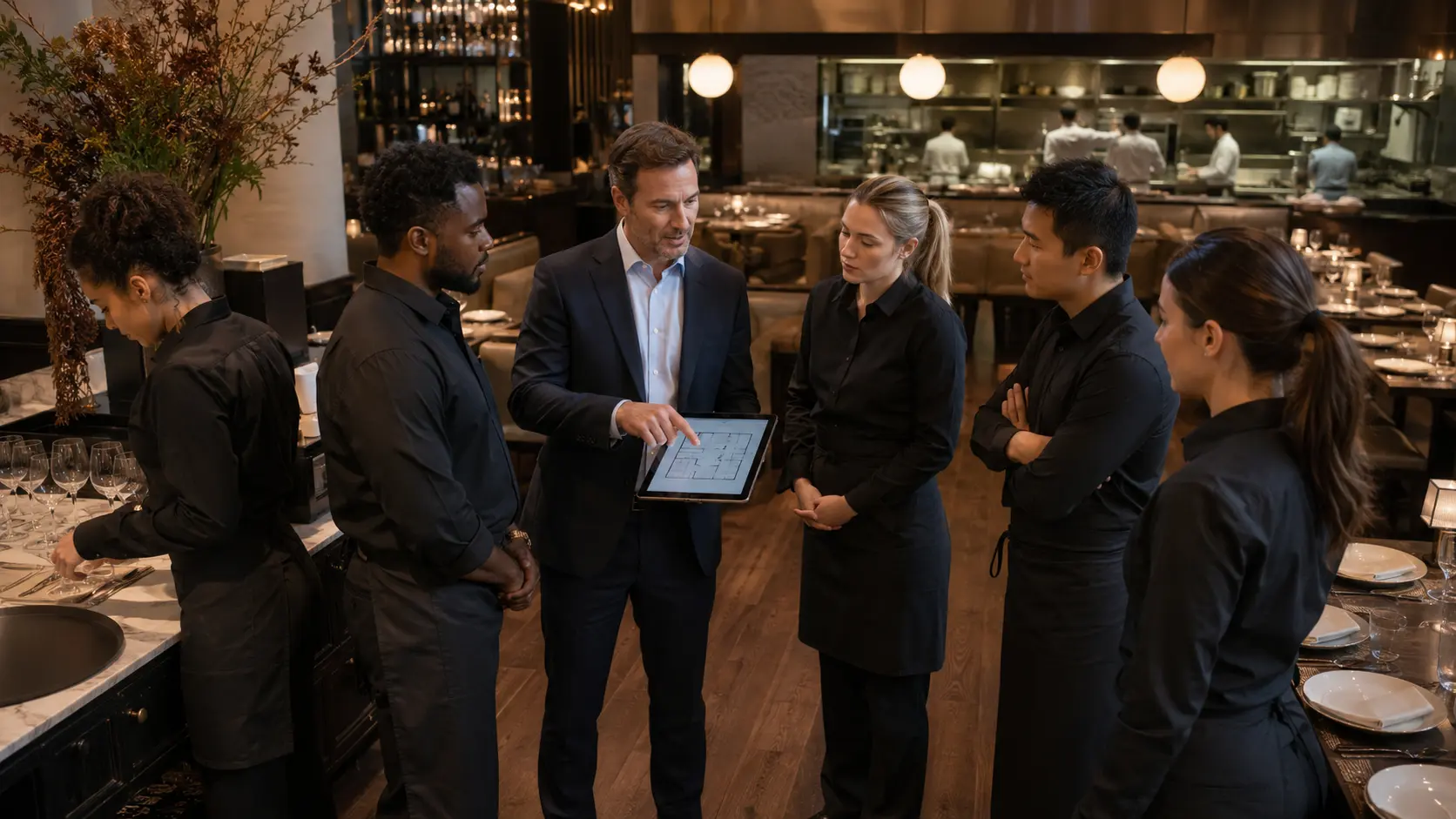
Two restaurant sections can contain the same number of tables and still create completely different workloads. One may include large parties, terrace tables and guests with fixed dining times. Another may have fewer seats but a long walking route, complex service equipment or several new reservations arriving together.
Effective restaurant station allocation does more than divide the floor evenly. It matches expected demand, section difficulty and employee capability, while making support and escalation clear before guests arrive.
Key Takeaways
- Allocate stations according to workload and complexity, not only table count.
- Use the latest reservations, arrival pattern and staffing position before assigning sections.
- Match demanding stations with the right experience and provide structured support where needed.
- Assign side duties, shared areas and backup responsibilities as clearly as table sections.
- Review station pressure during service and rebalance early when conditions change.
Why Station Allocation Matters
A station determines far more than where a server works. It affects walking distance, order volume, guest recognition, communication with the host, access to the bar or kitchen and the number of simultaneous service moments one person must manage.
Poor allocation can create an avoidable imbalance before service begins. One server receives several large tables at the same time while another has a lighter arrival pattern. A trainee is placed in the most technically demanding section without support. Shared side duties are left under a general team name, so nobody completes them.
The result is not simply an uneven workload. It can lead to delayed greetings, missed orders, slow table resets, weak product knowledge and frustrated employees. A clear allocation helps the team understand who owns each part of the guest journey and where help will come from when pressure increases.
Start With the Current Operational Picture
Do not copy yesterday's station plan automatically. Review the information that could change today's workload:
- Current reservations, expected covers and likely walk-in demand
- Arrival times and the concentration of bookings within each period
- Table sizes, large parties and approved event arrangements
- VIPs, returning guests and relevant special arrangements
- Dietary requirements or service needs that require additional coordination
- Indoor, terrace, private-dining or bar seating conditions
- Team attendance, experience, language ability and current training needs
- Known equipment, stock or layout restrictions
- Breaks, staggered start times and early-finishing employees
The manager should use the latest available reservation and staffing information. A plan prepared earlier may need to change if a booking increases in size, the weather affects the terrace or an employee becomes unavailable.
Assess the Difficulty of Each Station
Equal covers do not always mean equal work. Review each section using practical demand factors.
Number of seats and table mix
A section with several two-top tables may require more greetings, orders, payments and resets than one table serving the same number of guests.
Expected arrival pattern
Twenty guests arriving over ninety minutes create a different workload from twenty guests arriving within fifteen minutes.
Service complexity
Tasting menus, tableside preparation, extensive beverage service, private events or special menu arrangements may require more time and coordination.
Physical layout
Distance from the kitchen, bar, service station or payment point affects how efficiently the server can manage the section.
Guest and business priorities
Large parties, returning guests or approved special arrangements may require a particular level of experience or manager involvement. Only information legitimately needed for service should be shared with the assigned employees.
Use these factors to identify light, standard and demanding stations. The labels are not employee rankings; they describe the expected operational load for that service.
Match Stations to Team Capability
Avoid using station allocation as a reward, punishment or fixed hierarchy. Match the work to the team's capability while creating controlled development opportunities.
Consider:
- Knowledge of the menu, beverages and service sequence
- Experience with the outlet and its table numbering
- Ability to manage several tables at different stages
- Confidence with large parties, dietary communication or complex payments
- Communication with the host, runners, bar and kitchen
- Physical accessibility or formally agreed work requirements
- Current training goals and the support available during the shift
A newer employee can take responsibility for a manageable section with a named supervisor or buddy. Development should be deliberate: define what the employee owns, what requires verification and when support should step in. Giving someone a difficult station without a support plan is not effective training.
Allocate Support Roles and Side Duties
Table sections are only one part of the plan. Confirm who owns the work that crosses station boundaries.
Depending on the service model, allocate:
- Host and reservation control
- Food running and pass communication
- Beverage or sommelier support
- Table resetting and clearing support
- Bread, water or amenity service
- Private-dining or event coordination
- Shared service stations and equipment
- Restroom and guest-area checks
- Break relief and temporary station coverage
- Closing or handover duties
Avoid assignments such as “everyone checks the service station.” Shared responsibility often becomes no responsibility. Name a primary owner and, where necessary, a backup.
Build a Balanced Station Plan
Use a current floor plan and follow a consistent sequence:
- Mark tables that are unavailable, combined or reserved for a specific approved purpose.
- Plot confirmed reservations and expected arrival times.
- Identify the sections likely to receive the heaviest or most complex workload.
- Divide the floor into practical routes with clear table boundaries.
- Assign each section to a named employee based on capability and expected demand.
- Add runners, beverage support, buddies, break relief and manager coverage.
- Assign shared side duties and service-station ownership.
- Review whether one employee could receive several demanding tables at the same time.
- Record the allocation in the approved operational tool or format.
The restaurant manager daily checklist should confirm that the final allocation matches the current business forecast, attendance and known service risks.
Test the Plan Before the Briefing
Walk through likely service pressure before presenting the allocation to the team.
Ask:
- What happens if the first large party arrives early?
- Who greets a newly seated table while its server is processing payment?
- Who covers each station during breaks?
- Which server or supervisor supports a trainee during peak time?
- How will the team respond if the terrace closes or additional tables open?
- Who updates the host when a section is temporarily unable to accept another table?
If the answer is simply “the manager will handle it,” the support plan is incomplete. Managers need visibility and freedom to lead the floor; they should not be the unnamed backup for every gap.
Communicate the Allocation Before Service
Use the focused pre-shift briefing to explain:
- Each employee's station and table range
- Expected covers and important arrival periods
- Large parties and approved special arrangements
- Support roles, side duties and shared-area ownership
- Break coverage and shift changes
- Known service risks or temporary restrictions
- The communication method for seating, delays and station changes
- When employees should ask for support or escalate
Allow the team to question unclear boundaries. A floor plan that looks logical to the manager may create unnecessary crossing routes or leave one table between two sections without an obvious owner.
Adjust Stations During Service
The plan is a starting position, not a restriction that must remain unchanged all night. Monitor live demand and intervene before one section loses control.
Useful signs include:
- Several tables waiting to be greeted or cleared in one area
- A server repeatedly asking others to cover essential steps
- Orders from one station reaching the kitchen in a sudden group
- Delayed drinks, bill requests or table resets
- An unexpected large party, walk-in wave or change in seating area
- A team member becoming unavailable or requiring immediate support
Reallocation should be explicit. State which tables or duties are moving, who now owns them and whether the change is temporary or permanent. Inform the host and relevant support teams so new guests are not seated according to an outdated plan.
Do not move responsibility for an active guest request without confirming the handover. The guest should not need to repeat a request because the station changed.
Review the Allocation After Service
At the end of the shift, compare the plan with what actually happened:
- Which stations became overloaded, and at what time?
- Did the arrival pattern differ from the forecast?
- Were section boundaries practical?
- Was support available when promised?
- Did breaks create temporary gaps?
- Which employees handled their sections confidently?
- Where would coaching, knowledge or supervised practice help?
Use recurring patterns to improve future allocation. If the same station repeatedly struggles, the cause may be its layout, table mix, arrival pattern or lack of runner support—not the employee assigned to it.
Common Mistakes
- Dividing only by table count: The plan ignores covers, complexity, distance and arrival timing.
- Using the same stations every day: Changes in demand and staffing are not reflected.
- Giving the strongest employee every difficult table: The shift becomes dependent on one person and development stops.
- Leaving support informal: Employees do not know when or how help will arrive.
- Forgetting shared duties: Service stations and guest areas fall between section boundaries.
- Changing stations silently: The host and support teams continue working from the old plan.
- Treating allocation as performance judgment: Employees become defensive instead of discussing workload honestly.
Manager Checklist
Before service, confirm:
- The plan uses current reservations, staffing and operating conditions.
- Station difficulty reflects covers, arrivals, complexity and layout.
- Each section has one clearly named owner.
- Employee capability and development support have been considered.
- Hosts, runners, beverage support and break coverage are assigned.
- Shared areas and side duties have named owners.
- The team understands boundaries, support and escalation routes.
- A contingency exists for predictable changes in demand or staffing.
- The plan can be updated visibly during service.
Conclusion
Restaurant station allocation is a practical service-control decision. A balanced plan converts reservations, floor layout and team capability into clear responsibility before guests arrive.
Do not aim for identical sections. Aim for a fair and workable distribution of operational pressure, backed by clear support and active management. When the plan remains visible and adjustable, the team can respond to changes without losing ownership of the guest experience.
Frequently Asked Questions
How should restaurant stations be divided?
Divide stations using expected covers, table mix, arrival timing, service complexity and walking distance. Then match each section with an employee who has the appropriate capability and support. Equal table numbers do not necessarily create equal workloads, so review how demand is likely to develop during the service.
How many tables should one restaurant server handle?
There is no reliable universal number. Capacity depends on the service style, table size, menu complexity, support roles, technology, layout and employee experience. Managers should use the outlet's operating model and live demand, then monitor whether guests receive the required service consistently. Applicable employment and safety requirements must also be respected.
Should servers keep the same station every shift?
Consistency can help employees learn their area, but permanent allocation can create dependency and limit development. Rotate stations in a planned way while considering capability, training goals and available supervision. Do not place an employee in a demanding station simply to test them without a defined support plan.
When should a manager change station allocation during service?
Change it when actual arrivals, table progress, staffing or operating conditions make the original plan ineffective. Act before service failures accumulate. State exactly which tables or duties are moving, update the host and support team, and confirm the handover of any active guest requests.
Should station allocation be part of the pre-shift briefing?
Yes. Employees should leave the briefing knowing their table range, expected demand, side duties, support roles, break coverage and escalation points. The detailed floor plan should remain accessible during service so changes can be communicated and recorded clearly.